


Ethics is an Optics. (E. Levinas)
If it is true that a crisis gives rise to opportunity, once again it is Chinese thought that shows us the way. It is well known that in Chinese the ideogram for “crisis” is composed of two characters, one referring to danger and the other to opportunity—inseparably linked, like two sides of the same coin. In the face of a threat, the subtle fabric of Chinese thought reveals, there is always an opportunity—but seizing it is another matter entirely. A time of crisis, therefore, is an offering, an opening. After all, we too have a saying: “When one door closes, another opens.” Crisis, then, is a space in which the new matures and emerges—something that inevitably presents itself to us, yet demands clear vision, openness, and the ability to grasp uncertain and difficult events as opportunities.
Whether and how sustainability can be an advantage for policy within the European sphere often sounds like a riddle. It is evident that European policies on sustainable development, despite their good intentions, struggle and waver uncertainly in determining the direction to take. A host of questions arise: why, in Europe, is sustainability spoken of almost exclusively in terms of disclosure obligations? Why does the subject seem so often to end at the perimeter of reporting requirements, the thresholds of companies under obligation, the frameworks to be used? And why, somehow, does there seem to persist the equation (or equivalence) “competitiveness = simplification”? Which, put plainly, means reduction of reporting burdens—the first of the so-called “enablers” defined by the EU Competitiveness Compass. Is that really all there is to it? Is it truly that simple? Or are we looking at an overly simplified vision? Like an avalanche, thoughts roll downhill in cognitive chains that appear perfectly reasonable, but unravel by inertia without any critical control—so much for the original intentions behind the Green Deal and its aim to finance the transition.
Reading the opening statement of the document presented by Ursula von der Leyen, President of the European Commission, one cannot help but question the meaning of sustainability within this framework:
“Europe has everything it takes to win the race to the top. But at the same time, it must overcome its weaknesses to regain competitiveness. The Competitiveness Compass translates the excellent recommendations of the Draghi report into a roadmap. Now we have a plan. We have the political will. We need speed and unity. The world will not wait for us. All member states agree: the time to act is now.”[1]
Von der Leyen’s exhortation seems entirely commendable—yet is something missing? When one’s gaze falls into a blind spot, it cannot give form to what it does not see; it cannot be aware of what it is unable to grasp. Something—for someone—does not exist. The invitation, therefore, is to maintain an open observation, a vision that sees also “out of the corner of the eye.” In short: is it enough to develop (in the future) new savings and investment products to finance competitiveness (the third cross-cutting enabler of the aforementioned Compass)? Will we truly be globally competitive merely by developing savings products? Is it enough to support decarbonization to make “the EU an attractive place for manufacturing”?[2] Is this sustainability? What Europe lacks is a broader vision that would allow it to break free from the constraints of an idealistic perspective on sustainability and embrace the complexity of global interdependence—beginning with liberation from the inherited dependencies of the last seventy years.
At this juncture, a different perspective—a gaze from outside—may prove useful, helping to establish broader points of comparison and to reveal our blind spots. In other words, we must identify who truly stands outside the European perspective by attitude, history, culture, orientation, past, and future. Among the major players in the global market, the United States and China, the latter is by far the more interesting—precisely because, perhaps, the European Union is too close to the U.S. in cultural origins, geography, biography, and social-political orientation. Gabriel Crossley, correspondent in China for The Economist, in his article Post-solar Power: China hopes to dominate the next phase of green innovation[3], argues that China dominates the global market in the production of batteries, electric vehicles, solar panels, and other technologies linked to the green economy through a diversified strategy that includes, among other factors, the creation of strong internal competition, “generous” state funding—the well-known model of state capitalism—low-cost technologies, and remarkable speed and pervasiveness in global go-to-market strategies. Something does not quite add up: we still seem bound to our narrow view of China as distant from any sustainable perspective. A false myth? Perhaps there is something to be learned here—something we have yet to grasp.
The conditions that generate both innovation gaps and leaps forward in technological development are carefully examined in the Draghi Report, which focuses on competition between the EU, the U.S., and China regarding the technologies that will determine future global strategic relevance—and, implicitly, “who depends on whom.” The true global challenge, it seems, reveals a reversal of the trend established by decades of globalization and now centers on the ability of individual nation-states to free themselves, where possible, from dependencies within global value chains. This, with all its limits, represents a necessity for which Europeans are paying a high price—in energy supply, digital technologies, mobility, and other strategic sectors.
The Draghi Report starkly highlights both the strengths and weaknesses of the EU’s potential. As the accompanying graph indicates, Europe shows distinctive capacities in less complex technologies (at the lower end of the scale), particularly in sustainable mobility; yet, as the report comments, capability does not automatically translate into strategic advantage in the market:
“Europe has strong innovation potential to meet growing domestic and global demand for clean energy solutions. Although Europe is weak in digital innovation, it leads in clean technological innovation […] However, it is not guaranteed that the EU’s need for clean technologies will be met by domestic supply, given China’s growing capacity and scalability. […] Based on current policies, Chinese technology may represent the most cost-effective route to achieving some of these goals. With its rapid pace of innovation, low production costs, and state subsidies four times larger than those of other major economies, the country now holds a dominant position in global exports of clean technologies. Significant overcapacity is expected: by 2030 at the latest, China’s annual production capacity for solar photovoltaics will be double global demand, while its capacity for battery cells will at least meet global needs. Electric vehicle production is increasing at a similar pace. The EU is already witnessing a sharp deterioration in its trade balance with China, particularly in imports of electric vehicles, batteries, and photovoltaic products.”[4]
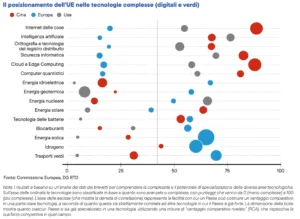
Possessing capabilities and strategic assets, then, does not automatically translate into a competitive advantage on a global scale. Even in the sectors—those at the lower end of the scale—where Europe could excel, it is losing the strategic asset race. Perhaps it has already lost it entirely.
In the other part (the upper end) of the graph, high-complexity technologies are already dominated—both in terms of expertise and strategic capacity—by China. This is a highly significant fact, giving substance to our concerns on two decisive parameters: competitive advantage in the global market, and dependency on crucial technologies. At present, China is investing in a new wave of “green” technologies, including emission reduction for hard-to-abate industries through carbon capture and storage (CCS), low-cost hydrogen production, and expansion of renewable energy (solar and wind).[5]
As for dependency—“who depends on whom”—China has shown greater foresight than its competitors, as demonstrated by its industrial policies for controlling rare earth elements. “It alone accounts for over 62% of global mining production, around 90% of total downstream processing, and 36.6% of the world’s rare earth reserves. China’s strategy for controlling rare earth metals has proven economically and geopolitically successful.”[6] Furthermore, China has exported rare-earth-based products (including imported ones) since 1973 and, between 1975 and 1990, established a unified industrial management approach known as the National Rare Earth Development and Application Leading Group. This reveals a long-term vision in place for decades. The U.S., by contrast, has grasped the dynamic perhaps too late, and under recent administrations has moved in a disjointed, limited, and counterproductive way—even for itself; witness the looming tariff policies, which can hardly be called long-term thinking. Moreover, China has developed increasing autonomy in global supply markets and has progressively and significantly reduced its foreign input dependence. “As a very large economy, China produces domestically a significant share of the resources and intermediate goods needed for its own production, thereby reducing its need to import components from abroad.”[7] This policy of self-sufficiency began over twenty years ago, around the early 2000s: “The country has further reduced its dependence on foreign supplies. This change is likely tied to strategies of productive self-sufficiency and reshoring—the ‘bringing back home’ of production phases previously carried out abroad.”[8]
Taken together, these observations show that the “nation of the dragon” displays a capacity for vision that the EU—more inclined to emphasize the moral or “ethical” aspects of its approach—seems to lack. China’s industrial development perspective is, in some respects, several decades ahead of Europe’s, especially in identifying opportunities linked to sustainability within a highly chaotic and uncertain context, and translating them into a competitive advantage that, over time, becomes insurmountable for other global actors. In this systemic dynamic, what appears most troubling is that as China’s foresight increases, so too does Europe’s dependence on the Chinese economy.
“Great disorder under heaven. The situation is excellent.”
[1] Commissione europea, Bussola dell’UE per riconquistare competitività e garantire prosperità sostenibile, 29.01.2025
[2] G.Crossley, “Post-solar Power, China hopes to dominate the next phase of green innovation The Economist, The World Ahead, 2025
[3] M. Draghi, Rapporto «Il futuro della competitività europea», 2024
[4] G.Crossley, ibid
[5] V. Mamerti, Come la Cina è diventata leader globale delle terre rare, Valori, notizie di finanza etica ed economia sostenibile, 2021. I dati potrebbero aver subito variazioni non significative dal 2021; questi scostamenti non risultano determinanti ai fini del ragionamento.
[6] La Cina vuole andare da sola, Desklavoce.info, ECO n°2/2025
[7] Ibid.
[8] Frase attribuita a Mao Zedong